Why a coating peels off bare or contaminated concrete, and what grinding fixes
Garage and Commercial Epoxy Flooring in West Palm Beach for surfaces handling chemicals, impacts, and continuous traffic starts with a plain fact: epoxy is only as good as what it's stuck to. Raw slab is slick with curing residue, old sealer, oil drips and tire marks, and a coating rolled over any of that sits on top like a sticker. It looks fine for a season, then lifts at the door line where the tires turn.
So the first day is grinding. The machine opens up the surface of the concrete so the epoxy has something to bite into, and it takes off what was never meant to stay. Oil spots get treated before they're coated, because oil keeps working its way up through a film. We look the slab over for damp patches too. Florida concrete lives in humid air and often on wet ground, and a floor that's still giving off moisture is a floor that will bubble.
That's the part nobody sees once the job is done, and it's the part that decides whether a Wellington garage still looks right in five years or needs redoing.
Crack repair, layered epoxy, flake and a sealed top coat, in the order that matters
Cracks come next. Slabs move, and a hairline you can barely see today will telegraph through a rigid coating tomorrow. We fill cracks with a flexible repair material instead of hard filler, so the floor can shift a little without opening the line back up. Then the base goes down.
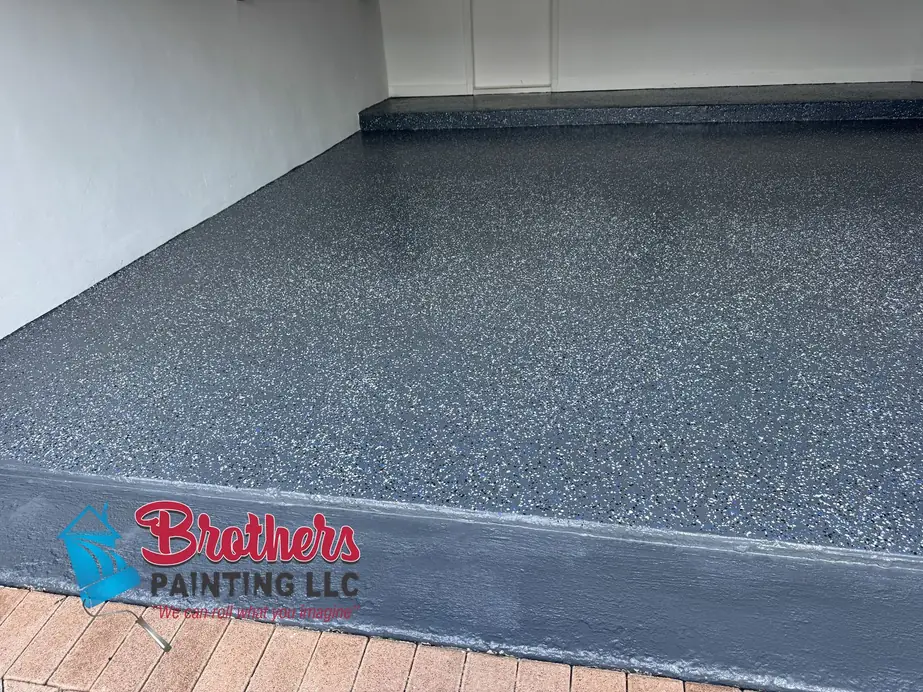
The system is built in layers, not rolled out as a single pass. A multi-layer epoxy gives the floor body, and decorative flake gets broadcast into the wet coat for color and texture underfoot. The flake isn't only for looks. It breaks up glare, hides the small scuffs a workshop floor collects, and gives wet shoes a little grip. You choose the blend, and the finished garage floor in our own work is a charcoal-blue with flake that shows what a mixed palette does in daylight.
A sealed top coat finishes it. That clear layer is what takes the wear: chemicals, rolling toolboxes, forklift traffic in a Delray Beach warehouse, the heat of a car that's just come in from I-95. Garages, warehouses, workshops, retail floors and industrial bays all follow the same order, with the system adjusted to how hard the room gets used.
Living with the floor: chemicals, hot tires, and what to do on mop day
A properly built epoxy floor handles the things that stain bare concrete, including oil, coolant, cleaning chemicals and the dark ring hot tires leave behind. Wipe spills when you see them rather than leaving them to sit for a week, and keep the floor clean with a soft mop or a dust mop and mild cleaner. Harsh scrubbing pads and aggressive solvents are what wear a good finish down early.
Heavy impacts are the real enemy. Dropped steel and dragged equipment can chip any coating, so rubber mats under jacks and stands are cheap insurance in a workshop. Retail and shop floors in Boynton Beach or Lantana do best with a simple cleaning routine the staff can actually follow.
Ask us for the cure window when we write up your scope, so you know when the floor can take foot traffic and when the car or the pallet jack can come back onto it. Request an epoxy flooring consultation to evaluate your concrete condition and discuss coating thickness, flake options, and the finish that suits how you use the space.