How a Drywall Patch Disappears Under New Paint
A repair that vanishes under fresh paint comes from a sequence done in order, with nothing skipped.
October 27, 2026 · 4 min read
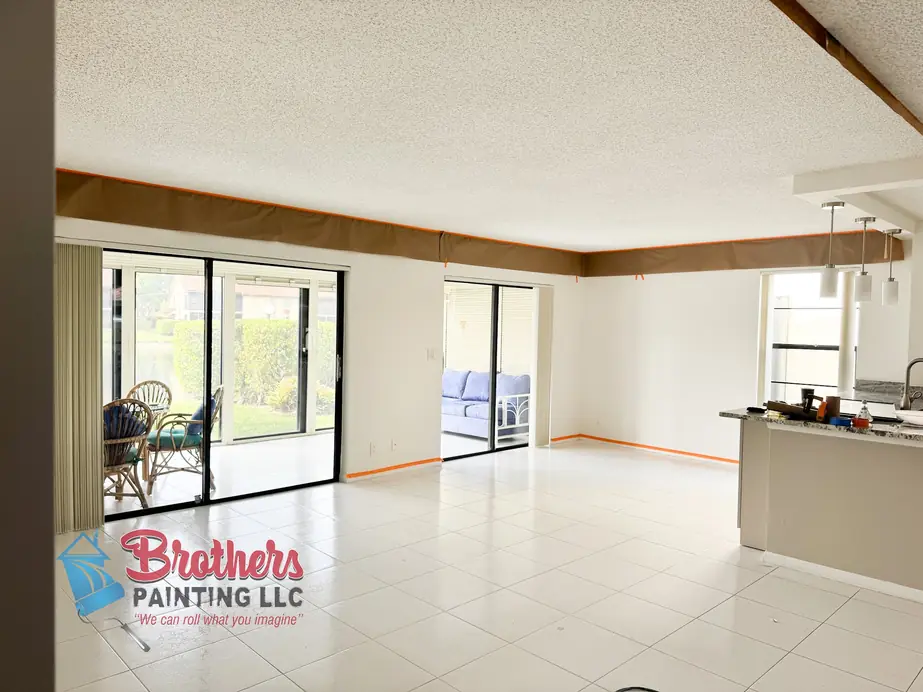
Fresh paint is honest. It shows every dent, ridge and shiny spot underneath it, especially when afternoon light rakes across a wall. That's why a repair that looked fine in bare joint compound can turn into a ghost the moment the color goes on. A patch that disappears isn't luck. It comes from a sequence, done in order, with nothing skipped. If you're a homeowner or property manager in Palm Beach County getting ready to repaint, here's what that sequence looks like and why each step earns its place.
Start by reading what's actually wrong
Before anyone mixes compound, the damage needs to be read. A doorknob hole, a settling crack and a water stain all look like cosmetic problems, but they're three different repairs. Treating them the same is how patches come back.
- Holes: small dents and nail pops get filled and sanded. Larger holes need backing or a patch piece set into the opening, then taped at the seams so the repair holds its shape instead of sinking.
- Settling cracks: houses and condos move a little over the years, and hairline cracks often show up near door and window corners. The crack is opened slightly, taped and floated so it doesn't telegraph back through the paint.
- Water marks: the stain is only the symptom. The source has to be found and fixed first. Then any soft or crumbling drywall is cut out and replaced rather than painted over.
Tape, float, sand, repeat
Tape gives a repair its backbone. Paper or mesh tape bridges the seam so the compound has something to grip. After that, the work is done in thin layers, not one thick glob. The first coat fills the damage and locks in the tape. Each later coat is spread wider than the last, so the edge of the repair thins out until it merges into the wall. That wide, shallow spreading is called feathering, and it's the difference between a patch you can't find and a flat spot that shows when you step back.
Every coat of compound needs to dry fully before it's sanded. Rushing that step is one of the most common reasons a repair cracks or shrinks later. Sanding should be a light touch, done with a light held at a low angle. A flashlight dragged across the wall shows low spots and ridges your eye misses in normal room light. If you can feel an edge with your fingertips, you'll see it once the paint is on.
Why primer is not optional on a repair
Joint compound is far more porous than the painted drywall around it. Roll finish paint straight over a patch and the patch drinks the paint differently from the wall, leaving a dull square right where the repair sits. Painters call that flashing. Primer seals the repair so it takes the finish coat at the same rate as everything around it.
Sheen matters just as much. A flat patch inside a satin wall catches light differently even when the color is identical. Good prep means priming the repair, then carrying the finish coat well past the patch edges so the sheen blends. Often that means painting the whole wall, corner to corner, instead of dabbing a touch-up circle. Older paint fades a little over the years, and a fresh dab on a faded wall almost never matches.
The extra step South Florida walls need
Palm Beach County air carries a lot of moisture, and drywall soaks it up. A stain from an AC drain line or a roof leak can mean the board is damaged beyond what compound can cover. A stain-blocking primer is usually part of the answer, because water marks tend to bleed through ordinary paint and come back as a tan ring.
But primer only works on a dry, sound surface. If a bedroom wall in a rental in Jupiter or a ceiling in a West Palm Beach condo keeps getting damp, fix the leak first. Painting over an active moisture problem just buys you a nicer-looking stain for a few months.
What a painter who does this right will tell you
When drywall repair is part of the paint job, you shouldn't have to coordinate a separate trade and then wonder who's responsible for how the finished wall looks. At Brothers Painting, a family-operated, licensed and insured painting contractor in West Palm Beach, patches are taped, floated, sanded, primed, feathered and sheen-matched before a finish coat goes on. The estimate is free and done on site, and it comes with a written scope, so you'll know what to expect before work begins. Once the team starts, they stay until the job is complete.
You can read more about this work on the drywall repair and sheetrock patching page at /drywall-repair-and-sheetrock-patching. If you've got a hole, a crack or a stain you want gone before the new color goes up, call (561) 633-3047 or request a free estimate.
Brothers Painting, LLC, (561) 633-3047
Call (561) 633-3047More articles
When to Schedule Cabinet Painting, and When to Refinish Instead
The right time to paint cabinets is before a deadline forces your hand, and the right method depends on what your cabinets are made of.
Interior Painting in West Palm Beach: Prep, Humidity and a Neutral That Sells
Most of what makes interior paint look good and last is done before the first coat of color.